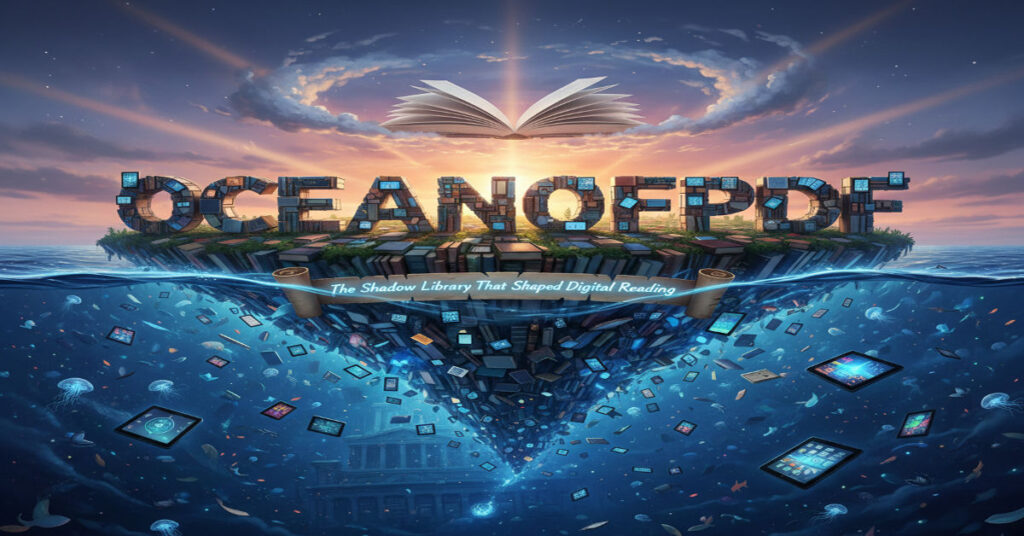
In the vast online landscape where information flows freely and fiercely, few digital names stir as much debate as OceanofPDF. For many global readers it became a shorthand for instant access to books magazines academic texts and manuals without subscription fees or library cards. Yet within months of its ascent the website became synonymous with copyright battles legal takedowns and questions about the ethical cost of “free” content. Few other platforms illustrate the tension between accessibility and intellectual property rights so vividly. It’s clear why users search for OceanofPDF readers want to know what it is how to access it why it remains controversial and whether it’s safe or legal.
OceanofPDF launched in the late 2010s as a simple repository of downloadable PDFs and EPUBs that spanned genres and subjects. Its interface was clean its promise attractive: search for a title and download a book with one click. Millions headed there each month drawn by the sheer breadth of the library and absence of paywalls. But that convenience came with cost and controversy. Authors and publishers called OceanofPDF one of the most infamous ebook piracy sites because it hosted copyrighted works without permission undercutting the legal markets that sustain creative industries. Legal pressure shut its original domain and forced proxies and mirrors to proliferate. Meanwhile safety concerns emerged around malware unsecured downloads and legal penalties for users in some countries. (All this shows why exploring OceanofPDF touches on law ethics technology copyright and digital culture.)
A Digital Library Born in the Gray Zone
OceanofPDF first appeared online around 2018 presenting itself as a digital bookshelf where users could search fiction non‑fiction academic texts and technical PDFs without costs or accounts. Its structure was straightforward: a search bar a catalog of titles and links to direct downloads in popular formats. For readers with limited budgets or inadequate access to formal libraries the site offered an appealing gateway to information otherwise behind paywalls or high prices.
Yet behind that simplicity lay a legal minefield. As early as mid‑2018 authors including Philip Pullman and others publicly decried OceanofPDF for distributing their copyrighted works without consent triggering complaints and takedown notices from major publishers. That pressure led to the original site’s shutdown and domain changes as operators sought to evade legal enforcement. Despite claims that it sought to “make information free and accessible” the crux remained that the platform shared works without permission from rights holders which violated copyright law in most countries.
Expert quote:
“Platforms that distribute copyrighted works without licensing agreements operate in a legal gray zone that almost every jurisdiction considers infringement,” says digital rights analyst Mia Chen, highlighting the fundamental legality issue that defined OceanofPDF’s existence.
OceanofPDF’s operational model underscored its precarious status: no subscriptions no accounts and no formal licensing arrangements — only a library sustained by user demand and domain hopping as takedown notices arrived.
Popularity Metrics: What the Numbers Reveal
OceanofPDF’s traffic tells a story of sustained global interest amid controversy. According to recent analytics data, the site (or its accessible domains) received over 19 million visits in a single month with an average session duration of more than seven minutes and relatively low bounce rates — metrics typical of engaged users browsing multiple resources. In the United States India and the United Kingdom alone millions of visits surfaced each month showing its global reach and the persistent appetite for free ebooks online.
| Metric | Value | Insight |
| Visits (Dec 2025) | ~19.02 M | High global usage despite legal issues |
| Avg session duration | 07:06 | Users actively interacting with content |
| Bounce rate | ~34.6% | Lower than many content sites, indicating deeper engagement |
| Top countries | US, India, UK | Broad global user base |
These figures hint at why OceanofPDF remained in discussions long after initial shutdowns: demand for free or low‑cost reading material is enormous and global, particularly among students researchers and readers in low‑income regions.
Expert quote:
“High engagement metrics on platforms offering free content can reflect both accessibility needs and users’ willingness to trade legal risk for immediate access,” explains cybersecurity expert Dr. Harold Simmons.
Legal and Ethical Quagmires
The fundamental tension around OceanofPDF was simple yet profound: how to reconcile the public’s desire for accessible knowledge with copyright holders’ rights over distribution and compensation. Copyright law in the U.S. under the DMCA and similar statutes elsewhere protects authors and publishers from unauthorized distribution of their works. Distributing copyrighted material without permission — as OceanofPDF did — constitutes infringement with potential penalties for operators and in some cases users.
| Legal Issue | Description |
| Copyright infringement | Unauthorized distribution of copyrighted material |
| Takedown notices | DMCA and similar actions leading to domain takedowns |
| Domain evasion | Operators switching domains to circumvent enforcement |
| User liability | Depending on jurisdiction, individual users may face penalties |
Some countries have pursued enforcement against those hosting or distributing pirated content, though prosecutions of casual users downloading single books have been rare. Still, legal experts caution that repeated or large‑scale downloading could trigger notices or penalties depending on local laws.
More than law, the ethical dimension drew criticism from authors who saw their creative labor undermined. Independent writers especially noted that piracy sites deprive them of revenue and threaten livelihoods. “Finding my own book on a piracy site was both surreal and frustrating,” one self‑published author reflected in an online forum, underscoring the human cost of unauthorized sharing.
Safety and Security: The Unseen Risks
Beyond legality and ethics, using sites like OceanofPDF carries security risks that many casual users underestimate. Many mirror or clone sites that claim to offer OceanofPDF content are unregulated and financed by ads or third‑party trackers that can introduce malware or phishing traps. PDF files themselves can be manipulated to contain malicious code that targets unsuspecting devices. Security analysts routinely warn that unverified downloads from such sources are a vector for malware infection and privacy breaches.
Users discussing their experiences online report mixed outcomes: some say they downloaded files without immediate issues, while others recount malware infections or unauthorized charges after visits. Whether these stories constitute direct causation or coincidence, they highlight the unpredictable nature of unvetted download sites.
Expert quote:
“Any platform that bypasses standard security practices for file distribution inherently increases risk — users should assume malware risk whenever they download from unauthorized sites,” warns cybersecurity consultant Andrea Lopez.
Alternatives That Respect the Rules
While OceanofPDF’s allure was undeniable, readers seeking free or affordable books have legal alternatives that respect copyright and offer safe access:
- Project Gutenberg: A vast archive of public domain books available free legally.
- Open Library: A digital lending library part of the Internet Archive with millions of titles.
- Google Books: Offers previews and full downloads where permitted.
- Library apps like Libby or OverDrive: Let users borrow ebooks using library memberships.
These options illustrate that the demand for accessible reading doesn’t require piracy — only awareness and use of legitimate channels.
Takeaways
- OceanofPDF became popular because it offered free ebook downloads across genres.
- It operated by distributing primarily copyrighted material without permission.
- Legal pressure led to takedowns and frequent domain changes.
- Traffic data shows continued high engagement despite controversy.
- Using such sites carries legal and security risks.
- Ethical concerns include undermining authors’ revenues and rights.
- Legal alternatives exist that provide free or affordable reading without risk.
Conclusion
OceanofPDF’s story is a microcosm of the broader debates around access to information intellectual property rights and the internet’s evolving role in culture and learning. Its meteoric rise reflected deep global demand for knowledge unbounded by cost or geography. But that appeal came with legal, ethical and security costs that have kept its legacy contentious. In the end, readers seeking to balance their thirst for books with respect for creators’ rights and their own digital safety may find that legitimate platforms offer a more sustainable path. OceanofPDF looms large in memory not because it was flawless but because it forced a reckoning with what “free” really means in the digital age.
FAQs
Is OceanofPDF legal to use?
No. Because it distributes mostly copyrighted works without permission, using it can violate copyright laws in many countries.
Can I get viruses from OceanofPDF?
Yes. Downloads from unverified mirror sites may contain malware or expose you to phishing and other security risks.
Why was OceanofPDF shut down?
It faced legal complaints and takedown notices from authors and publishers for hosting unauthorized copyrighted material.
Are there safe alternatives for free ebooks?
Yes. Project Gutenberg Open Library Google Books and library borrowing apps provide legal access to many free ebooks.
Could I be prosecuted for downloading a book?
Prosecution of individual users is uncommon, but repeated infringement can expose users to legal risk depending on local laws.
REFERENCES
Wikipedia. (n.d.). OceanofPDF. https://en.wikipedia.org/wiki/OceanofPDF
Semrush. (2026). oceanofpdf.com Website Traffic, Ranking, Analytics. https://www.semrush.com/website/oceanofpdf.com/overview/
Elivestory. (n.d.). Is Oceanofpdf Worth It: Uses, Benefits, Risks. https://www.elivestory.com/oceanofpdf/
Wondershare. (n.d.). Is OceanOfPDF Safe? Risks, Legality & Better Alternatives. https://pdf.wondershare.com/pdf‑knowledge/is‑oceanofpdf‑safe.html