
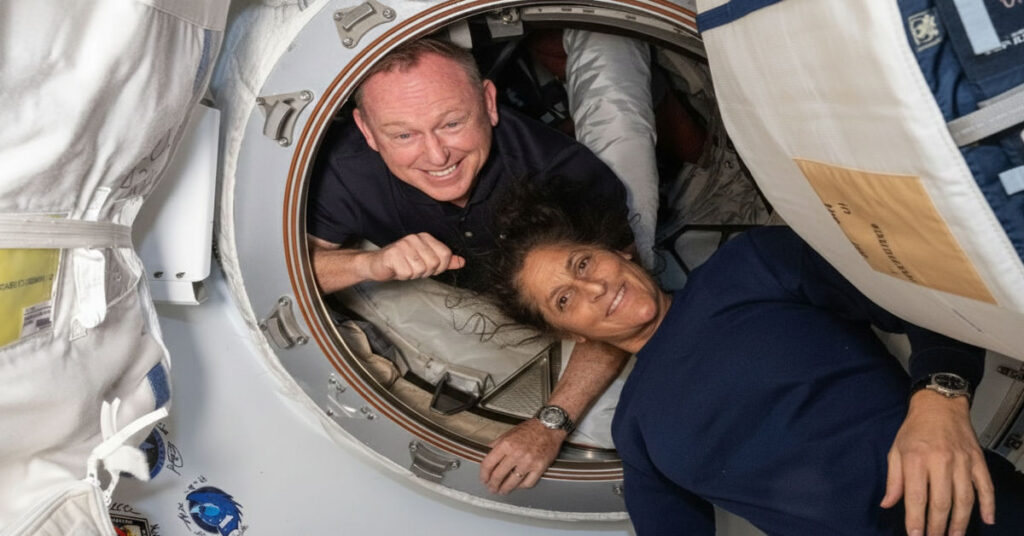
On June 5, 2024, NASA astronauts Barry “Butch” Wilmore and Sunita “Suni” Williams launched toward the International Space Station on what was supposed to be a short test flight of Boeing’s new Starliner spacecraft. The goal was clear and uncomplicated eight‑day mission to dock, test systems and return home safely. Within hours, however, those plans unraveled as technical issues with Starliner’s propulsion system made a safe return impossible. Over the next nine months, Wilmore and Williams would remain aboard the orbiting laboratory, their mission unexpectedly extended as engineers and managers worked through spacecraft faults and reshuffled crew rotations. Astronauts Stuck in Space odyssey ended on March 18, 2025, when they finally splashed down off the Florida coast aboard a SpaceX Crew Dragon capsule after 286 days in space — 278 days longer than planned.
The prolonged mission caught global attention not simply because of its duration but because it highlighted the complexity and interdependence of modern human spaceflight, where private launch systems and international partners weave together schedules and risks. Within the first 100 words of this story, the answer to why these astronauts remained in orbit emerges: Boeing’s Starliner spacecraft could not safely return them, forcing NASA to adjust long‑standing ISS crew logistics at a moment of intense public and political focus on space exploration.
Wilmore and Williams are seasoned spacefarers with multiple missions behind them, yet this unexpected chapter tested not only engineering margins but psychological resilience and international coordination. What unfolded over nearly ten months offers lessons for future spacecraft certification, commercial partnerships, and life in microgravity, with implications that reach far beyond this singular mission.
A Short Mission Turns Long
When Starliner lifted off from Cape Canaveral, Florida, it carried confidence in Boeing’s promise to restore a second U.S. human launch capability after the Space Shuttle’s retirement. The spacecraft successfully docked with the International Space Station on June 6, 2024, but problems surfaced quickly: helium leaks and thruster malfunctions raised concerns about Starliner’s ability to safely fire its engines for deorbit and reentry. NASA and Boeing agreed that returning Wilmore and Williams aboard Starliner was too risky, and the capsule was sent back to Earth uncrewed.
Rather than flying them home on Starliner later, NASA decided to embed the pair into the ISS’s regular crew rotation. That meant Wilmore and Williams would live and work aboard the station until a different spacecraft became available. SpaceX’s Crew Dragon, already part of NASA’s Commercial Crew Program, was eventually tasked with their return, but only after replacement crews arrived and mission schedules were adjusted.
This pivot exemplified how space agencies balance safety, hardware readiness and mission cadence. Boeing’s setbacks did not leave the astronauts in immediate danger, but they did complicate plans that had been years in the making. NASA officials called it a pragmatic solution that ensured continuous ISS staffing and upheld safety standards.
Inside the Space Station: Life on Extended Stay
Daily life aboard the ISS is regimented, but nine months is far longer than the initial eight days planned for this mission. Wilmore and Williams seamlessly joined ISS Expedition routines, conducting scientific experiments, maintaining station systems, and participating in spacewalks. Williams set a career record for aggregate spacewalk time by a woman during this mission.
Astronauts adhere to strict exercise regimens to counteract the effects of microgravity on muscles and bones. Station routines include research on biology, physics, Earth observation and technology demonstrations. Wilmore and Williams also assumed leadership roles; Williams served as station commander for part of their extended stay.
The social aspect of station life also mattered. The ISS community comprises astronauts and cosmonauts from around the world, providing support and perspective when plans change drastically. Wilmore later reflected that teamwork and routine helped sustain morale. One fellow crew member radioed as the return craft prepared to depart: “It’s been a privilege to call the station home.”
Timeline of the Unplanned Odyssey
| Date | Event |
| June 5, 2024 | Starliner launches Wilmore and Williams toward ISS. |
| June 6, 2024 | Starliner docks with ISS but shows technical issues. |
| September 2024 | Starliner returns unmanned; Crew Dragon remains docked with empty seats. |
| March 16, 2025 | SpaceX Crew‑10 arrives with replacement crew. |
| March 17, 2025 | Wilmore and Williams depart ISS aboard Crew‑9 Dragon. |
| March 18, 2025 | Splashdown off Florida after 286 days. |
This structured snapshot shows how the mission evolved, from a brief test flight to a prolonged station tenure disrupted by technical challenges and schedule shifts.
When Hardware Fails: Starliner’s Propulsion Setbacks
Boeing’s Starliner was designed to compete with SpaceX’s Crew Dragon as part of NASA’s efforts to foster commercial crew transport. Early tests for Starliner had shown promise but also revealed complications. During this flight, helium leaks — key for pressurizing propellant tanks — and issues with thrusters compromised confidence in the capsule’s ability to execute a safe deorbit burn. NASA engineers decided that risks outweighed benefits for crewed return operations.
An unnamed NASA propulsion expert summarized the concern at the time: “Reliable thruster performance is non‑negotiable for reentry Astronauts Stuck in Space. Without redundancy and validated helium pressurization, we cannot certify a safe descent.” Similar sentiments have appeared in NASA technical reviews, emphasizing the importance of robust redundancy in spacecraft design.
Boeing continues investigative work to understand root causes and implement fixes in future Starliner missions. NASA later announced plans for an uncrewed Starliner test flight to validate upgrades before crewed launches resume.
Beyond Safety: Commercial Crew Complexity
NASA’s Commercial Crew Program relies on industry partners to design, build and operate spacecraft that carry astronauts to and from Earth orbit. The model reduces costs and expands capacity, but it also introduces layers of inter‑company coordination. SpaceX’s Crew Dragon and Boeing’s Starliner both underwent rigorous certification processes, but Starliner lagged behind due to test delays and hardware issues.
Steve Stich, NASA’s Commercial Crew Program Manager, reflected after the astronauts’ return: “This has been nine months in the making, and I couldn’t be prouder of our team’s versatility, our team’s ability to adapt and really build for the future of human spaceflight.”
Space industry analysts note that redundancy between providers remains vital for ISS operations Astronauts Stuck in Space. When one system falters, another must fill the gap to ensure safety and mission continuity. This mission underscored both the promise and pitfalls of a multi‑provider strategy.
What It Was Like Up There
Astronauts often describe space as an intense but rewarding environment. Being confined to 420 kilometers above Earth for nine months tested every aspect of daily life aboard the ISS. Wilmore later recounted to media that while the extended stay wasn’t part of the original plan, maintaining structure and focusing on meaningful tasks helped them cope.
During downtime, astronauts look at Earth’s curvature, engage in educational outreach and maintain personal connections via video calls. According to ISS behavioral specialists, maintaining psychological wellbeing through routine and purpose is as critical as physical exercise.
Table of Key Mission Stats
| Metric | Value |
| Duration in space | 286 days |
| Orbits around Earth | 4,576 |
| Distance traveled | ~195 million kilometers |
| Spacewalk hours (Williams) | 62 hours over nine spacewalks |
| Original planned mission length | 8 days |
These numbers place the unintended mission in perspective alongside other long‑duration spaceflights while highlighting how far the mission diverged from its initial intent.
Expert Perspectives
Steve Stich, NASA Commercial Crew Program Manager: “Our ability to adapt and build for the future of human spaceflight was tested and proven.”
Nick Hague, Crew‑9 Commander: “I see a capsule full of grins ear to ear.”
SpaceX Mission Control Radio Call: “On behalf of SpaceX, welcome home.”
These voices anchor the technical narrative in the human experience of spaceflight, blending operational pride with relief and camaraderie.
Takeaways
- NASA astronauts Butch Wilmore and Suni Williams spent an unplanned 286 days aboard the ISS due to Boeing Starliner technical issues.
- Starliner’s thruster malfunctions and helium leaks prevented a safe crewed return.
- A SpaceX Crew Dragon capsule ultimately brought them home.
- Their extended stay demonstrated the resilience of ISS operations and international partnerships.
- Commercial crew redundancy proved essential when one system faltered.
Conclusion
The story of Butch Wilmore and Suni Williams’ extended mission aboard the International Space Station is more than an anomaly in timing. It is a case study in risk management, commercial collaboration, and human adaptability. While technical failures with Boeing’s Starliner shifted plans dramatically Astronauts Stuck in Space, NASA’s broader strategy ensured that the astronauts remained safe, productive and connected to Earth. Their return on a SpaceX Crew Dragon capsule underscored the value of having multiple pathways for human spaceflight.
In reflecting on their journey, Williams remarked that purpose and routine made the months in space meaningful, not merely bearable. Their experience offers lessons for future missions to the Moon, Mars and beyond, where uncertainties will be greater but preparation and cooperation even more essential.
FAQs
Why were Butch Wilmore and Suni Williams Astronauts Stuck in Space?
They could not return on Boeing’s Starliner due to propulsion and helium leak issues, so NASA extended their ISS stay until another vehicle, a SpaceX Crew Dragon, was available.
How long did they spend in space?
They spent 286 days aboard the ISS, far longer than the planned eight.
Did the astronauts face danger while waiting?
NASA maintained safety throughout; ISS life support and planning ensured no immediate danger.
What will Boeing do next with Starliner?
Boeing is planning uncrewed test flights to validate upgrades before future crewed missions.
What did they do during the extended mission?
They conducted research, station maintenance and spacewalks, integrating into long‑duration ISS operations.
REFERENCES
Associated Press. (2025, March 18). NASA astronauts Butch Wilmore and Suni Williams return to Earth after 9 months stuck in space. AP News. https://apnews.com/article/nasa-astronauts-butch-wilmore-suni-williams-iss-return-xyz
Euronews. (2025, March 19). NASA astronauts Sunita Williams and Butch Wilmore return to Earth. Euronews. https://www.euronews.com/next/2025/03/19/nasa-astronauts-butch-wilmore-and-suni-williams-return-to-earth-after-9-months-stuck-in
ABC News. (2025, March 20). Inside the mission that brought NASA astronauts home. ABC News. https://www.abc.net.au/news/2025-03-20/astronauts-return-iss-dragon-spacex/105070946
ABC News Timeline. (2024). Timeline of Boeing’s Starliner mission that left NASA astronauts aboard ISS. ABC News. https://abcnews.go.com/US/timeline-boeings-starliner-mission-left-nasa-astronauts-aboard/story?id=119867727
Houston Chronicle. (2026). Starliner spacecraft will fly uncrewed. Houston Chronicle. https://www.houstonchronicle.com/news/houston-texas/space/article/boeing-starliner-uncrewed-21205533.php