
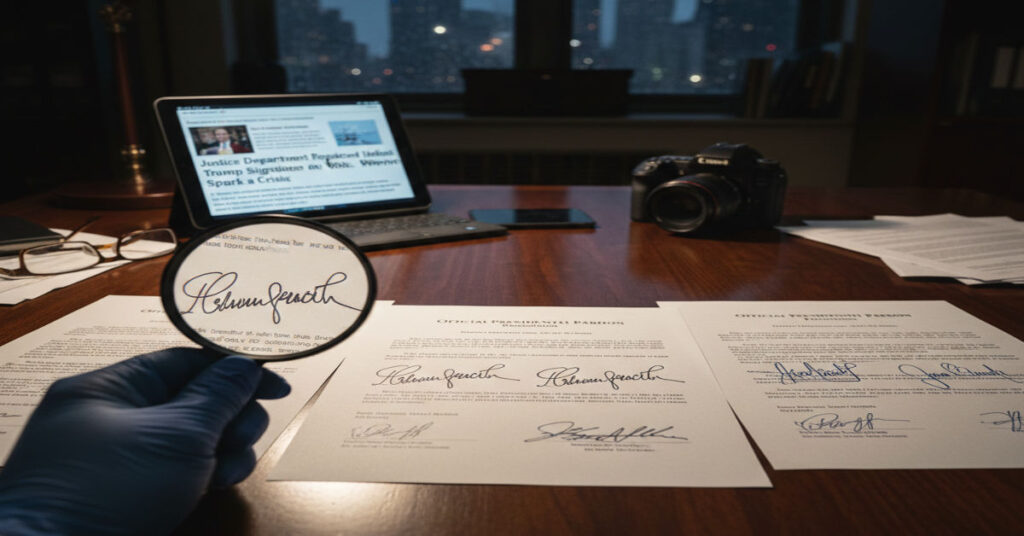
In early November 2025 Justice Department quietly replaced multiple presidential pardon documents on its official website after observers noticed the identical replication of President Donald Trump’s signature across them. Within hours of the online scrutiny the department posted updated versions with distinct signatures, saying a single signed page was mistakenly duplicated online because of a “technical error.” Critics immediately questioned why seven separate pardon orders appeared to share pixel‑perfect matching signatures and whether this pointed to procedural shortcuts in clemency processing or deeper governance Justice Department Replaced Identical Trump Signatures on Recent Pardons failures.
The episode landed at the intersection of technology, public records management and political optics. Trump himself has derided the use of autopens by former President Joe Biden, arguing that mechanical signature devices undermine legal legitimacy. Yet these identical signature files highlighted the fragility of digital trust in government transparency and the operational risks when document issuance pipelines rely on brittle systems without adequate checks. This article reconstructs what happened in detail, explores what crimes the pardoned individuals committed, lays out official explanations, and examines why this matters beyond partisan debate. It investigates the technological, legal, and institutional dimensions of how presidential pardons are authenticated, posted online, and interpreted by the public and legal experts alike.
The Anatomy of the Signature Replacement
Observers first flagged the issue when images and PDFs of seven pardon orders dated November 7 showed the exact same signature across files for Darryl Strawberry, Glen Casada and Michael McMahon among others. Forensic questioned document examiners noted individual signatures almost never replicate identical design features, making the appearance of exact copies highly unlikely in legitimate hand signatures.
The department removed and replaced the files, with a spokesperson attributing the repetition to a single signed document being uploaded multiple times. The White House echoed the assertion that Trump personally signed each pardon despite the online mis‑upload. Critics immediately tied the episode to Trump’s earlier attacks on Biden’s alleged autopen use, labeling the corrections politically ironic.
Legal experts clarify that signature uniformity in PDFs does not void the legal validity of a pardon if the president intended to grant clemency. Presidential pardons derive their force from constitutional authority and formal issuance, not the pixel pattern in online scans. Nonetheless credentialing and archival integrity are central to public trust in government archives and records.
Who Was Pardoned and Why It Matters
Below is a concise comparison of the key individuals whose pardons initially carried identical signatures:
| Name | Conviction | Implication |
| Darryl Strawberry | Tax evasion and drug charges in the 1990s | A cultural figure whose pardon stirred media commentary on rehabilitation narratives and clemency choice. |
| Glen Casada | Wire fraud and kickback scheme in Tennessee | Former state speaker convicted for involvement in a legislative contracting scandal. |
| Michael McMahon | Federal charges linked to an international harassment campaign | Former NYPD sergeant whose pardon raised questions of policy on law enforcement misdeeds. |
The broader list of executive clemency issued in Trump’s second presidency includes more than 1,600 individuals spanning high‑profile cases and blanket January 6 reprieves. Institutional critics have underscored that mass and selective pardons bear consequences on public safety, restitution for victims, and perceptions of political fairness.
Technology and Document Workflow: Where It Broke
From a technology‑focused perspective the incident raises glaring questions about how official federal documents are processed digitally. The workflow for publishing pardon documents should include redundancy checks, cryptographic checksums or metadata validation to ensure authenticity and uniqueness. Instead a probable file duplication exposed a weak oversight layer in the document pipeline.
Tom Vastrick of the American Society of Questioned Document Examiners emphasized that identical signatures across multiple unique legal instruments are virtually impossible without copying and pasting or using mechanical means, highlighting why observers noticed the anomaly.
Graphical signing technologies and PDF management systems are central to modern government record release. Effective practices involve strict audit trails, digital signatures, and tamper‑evident logging. As government agencies increasingly post legal documents online, robust digital rights management and hardened content delivery pipelines are not luxuries but necessities to preserve the integrity of presidential records.
Political Fallout and the Autopen Debate
The signature replacement unfolded against a backdrop where Trump has vocally attacked Biden’s use of autopen devices for signature replication. Echoing this stance Trump has declared certain Biden pardon actions void on social platforms, asserting that autopen use undermines legal effect. Experts widely disagree that autopen use invalidates presidential acts where intent is clear.
This episode compounded debates about how modern presidents authenticate their signatures amid high volumes of executive actions. Historically presidents have used autograph devices for routine business; courts have recognized this practice as valid under constitutional law. Scholars note that intent, not tooling, remains central to legal effect. Yet disputes over symbolic forms of signing have become fodder in broader political battles.
The corrective action by the Justice Department underscored political irony; critics fastened on past administration criticisms to contrast current procedural missteps. The episode even surfaced in legislative committee discussions regarding oversight of White House record‑handling.
What Legal Experts Say
Legal scholars generally agree that signature anomalies in web‑posted documents do not, in themselves, void presidential pardons. Constitutional precedent vests clemency power in the president. Former law professor Frank Bowman explains that courts attach legality to the act of pardoning so long as the president intended the outcome even if the signature method is unusual. Opponents emphasize record accuracy and public accountability as separate but essential domains.
Another expert highlighted that public perception of presidential legitimacy depends on transparent, traceable record keeping. A failure to maintain this can erode trust even if legal potency remains intact.
Timeline of Events
| Date | Event |
| November 7 2025 | Trump signs multiple pardon orders including Strawberry, Casada, McMahon. |
| Mid‑November 2025 | Online observers report identical signatures on those documents. |
| Hours later | DOJ replaces PDFs with versions showing varied signatures, calling it a technical upload error. |
| Subsequent days | Political and legal debate expands on signature authenticity and broader clemency practices. |
Expert Voices
“Signature replication is a red flag in document forensics because natural variability is the norm in genuine hand signatures,” notes a questioned document specialist.
A constitutional law analyst observed “the validity of a pardon rests on presidential intent and formal issuance, not on the pixel pattern in an online copy.”
A records management professional commented, “This incident highlights the urgent need for procedural automation that flags duplicates before they reach public repositories.”
Takeaways
• Digital document integrity matters as much as legal authority in public trust.
• Identical signatures triggered scrutiny not because pardons were invalid but because modern workflows lacked safeguards.
• Public perception of authenticity is shaped by both political narrative and technological process.
• Presidential clemency powers remain constitutionally strong regardless of signature method.
• The incident may spur improvements in federal digital record‑keeping.
Conclusion
The Justice Department’s replacement of identical Trump signatures on recent pardon documents underscores a convergence of technology, law, and politics. While the incident did not alter the legal force of the pardons it exposed fragilities in how official federal documents are processed and presented in the digital age. In an era where public trust in institutions already strains toward breaking the controls and workflows behind seemingly mundane acts like document uploads gain outsized significance. Crucially the event serves as both a cautionary tale for digital governance and a reflection of how symbolic technology debates are intertwined with partisan battles over legitimacy of Justice Department Replaced Identical Trump Signatures on Recent Pardons. Strengthening digital integrity systems in government archives and clarifying public communication protocols can help restore confidence in foundational processes where law, records, and public access intersect.
FAQs
Did Trump use an autopen for these pardons
Legal consensus is that even if an autopen were used the pardon remains valid if the president intended the act. The DOJ said Trump hand‑signed each pardon.
What crimes did Darryl Strawberry, Glen Casada and Michael McMahon commit
Strawberry was convicted of tax and drug offenses. Casada was convicted for a kickback scheme. McMahon faced federal charges tied to an international harassment campaign.
Why did the DOJ replace the signatures
Officials attributed the initially identical signatures to a technical error where the same file was uploaded multiple times.
What did Trump say about Biden autopen
Trump has publicly attacked Biden’s use of autopen signatures, at one point declaring certain Biden pardons void because they were allegedly autopen signed.
Are there other recent Trump pardons with signature issues
There have been no verified additional replacements beyond the mid‑November event regarding identical signatures.
REFERENCES
Associated Press. (2025, November). Justice Department quietly replaced ‘identical’ Trump signatures on recent pardons. AP News. https://apnews.com/article/trump-pardon-biden-justice-department-ed-martin-d525b1911534a40f70394fddf396acc1
Tennessee Lookout. (2025, November). Trump signature on Casada pardon identical to others. Tennessee Lookout. https://tennesseelookout.com/2025/11/17/trump-signature-on-casada-pardon-identical-to-others/
Helmore, E. (2025, November). Questions arise over strikingly similar signatures by Trump on recent pardons. The Guardian. https://www.theguardian.com/us-news/2025/nov/15/trump-signatures-clemency-orders
Forbes. (2025, November). Trump Addresses Shutdown And Controversial Pardon In ‘60 Minutes’ Interview. Forbes. https://www.forbes.com/sites/siladityaray/2025/11/03/trump-60-minutes-interview-says-he-doesnt-know-who-binance-founder-is-despite-pardoning-him
Wikipedia. (2026). List of people granted executive clemency in the second Trump presidency. Wikipedia. https://en.wikipedia.org/wiki/List_of_people_granted_executive_clemency_in_the_second_Trump_presidency