
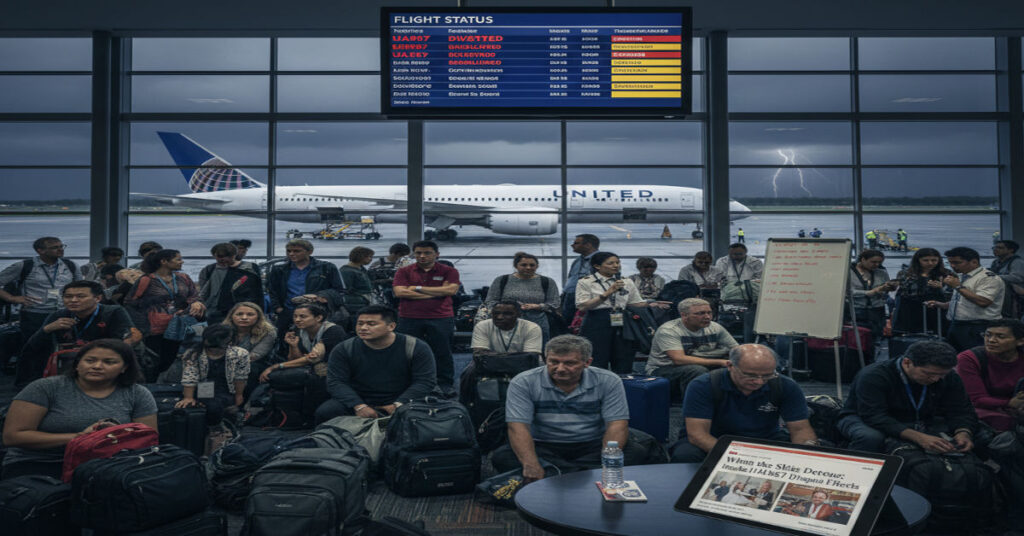
United Airlines Flight UA967, scheduled on August 24, 2025 to fly nonstop from Naples (NAP) to Newark Liberty International Airport (EWR) was diverted mid‑Atlantic to St. John’s International Airport (YYT) in Newfoundland after a technical issue aboard its Boeing 767‑300ER aircraft. The diversion occurred after roughly seven hours of flight time and led to an arrival in Newark more than ten hours behind schedule following aircraft swap and continuation of the journey.
In business terms, this event raises strategic questions about airline operations, reliability of aged fleets, passenger service obligations and cost trade‑offs when unexpected diversions occur. For frequent flyers and industry watchers, it also highlights how carriers manage risk and disruption across long‑haul international routes and the economic incentives at play when aircraft age, infrastructure limits and schedule expectations intersect.
What happened on UA967, where it diverted, why and its delay impact on passengers. What follows is a structured analysis of the operational, economic and customer‑experience dimensions of this incident, including comparisons to similar events, expert commentary and implications for the airline and its customers.
The UA967 Diversion: What We Know
United flight UA967 departed Naples on August 24, 2025 about three hours behind schedule and flew toward Newark when, after seven hours over the Atlantic, the crew elected to land in St. John’s, Newfoundland, due to a technical issue aboard the Boeing 767‑300ER with registration N671UA.
The airline did not publicly disclose specifics of the malfunction. Instead it confirmed that the diversion was a precautionary safety decision and that passenger well‑being was the priority. No injuries were reported. A replacement 767 (N673UA) continued the service, arriving in Newark more than ten hours late on the morning of August 25.
This sequence of events combines elements of technical risk, fleet management and customer disruption. In a business context, diverting a long‑haul flight represents a costly decision for airlines, yet one that is frequently mandated by crews, maintenance control, or regulations when safety thresholds are crossed.
Airlines, Long‑Haul Fleets and Operational Risks
For airlines, long‑haul operations are a balance of route economics, fleet utilization and risk mitigation. Older aircraft like the Boeing 767‑300ERs in United’s international fleet are often retained because they remain economically viable despite higher maintenance costs compared to newer models. These airframes have been reliable workhorses for decades, but aging fleets can present more frequent unscheduled technical issues.
In UA967’s case, the technical anomaly was significant enough for the flight crew and dispatch to select St. John’s, a capable diversion airport, rather than continuing toward the original Newark destination. Operationally, this suggests that the system affected was beyond what could be managed in flight or deferred until landing — a decision that aligns with conservative safety protocols that govern transatlantic operations.
Industry expert Jonathan Peters, an airline operations analyst, told ElevenLabsMagazine.com that “long‑haul diversions are never taken lightly because they disrupt not only this flight but the broader network schedule, requiring aircraft swaps, crew changes and often overnight accommodations.” He adds that “the decision calculus prioritizes passenger and crew safety but also considers where the aircraft can be repaired or evaluated efficiently.”
Passenger Impact and Cost Realities
From a passenger perspective, the diversion transformed a planned 10+‑hour flight into a journey exceeding 20 hours door to door. Airlines generally maintain obligations to care for passengers during extended delays, including meals, lodging and rebooking support when necessary. A senior airline industry consultant, Maria Velasquez, noted that “compensation and service recovery costs are significant for international diversions because they can cascade into missed connections and additional accommodation needs that carriers must address.”
For UA967 passengers, the delay meant waiting in St. John’s for the replacement aircraft and then enduring the late arrival into Newark, which, in some cases, might have caused missed onward connections. United’s customer service policies — often influenced by EU and US regulations and competitive pressures — typically include rebooking and support, though passengers sometimes pursue additional compensation depending on ticket fare conditions and regulatory jurisdiction.
The chart below illustrates typical cost categories an airline incurs in diversion scenarios.
| Cost Category | Description | Impact Type |
| Ground Support | Fees for airport handling, parking, ground crew | Direct operational cost |
| Passenger Care | Meals, hotel rooms, lounge access | Variable cost per diverted passenger |
| Aircraft Swap | Ferrying replacement aircraft | Additional fuel and crew costs |
| Schedule Ripple | Crew duty windows, disrupted rotations | Network cost impact |
Business Incentives and Network Effects
Flight diversions have broader implications beyond the single flight. For carriers like United Airlines, repeated diversions or delays can influence passenger confidence, booking patterns, and ultimately revenue on key international routes. Newark serves as a major European gateway for United and its network partners. Operational disruptions there — whether from technical diversions or broader airline network congestion — can distort capacity planning.
A recent United corporate communications summary noted ongoing efforts to improve operations at Newark, including infrastructure investments and collaboration with air traffic authorities to smooth arrival and departure flow. These systemic improvements aim to reduce delays that compound the impact of isolated divert events.
Economically, diversions also force airlines to balance between maintaining network integrity and absorbing costs. An economist in travel markets, Rohan Singh, observed that “airlines must guard margins while simultaneously reassuring passengers that flying remains reliable. Events like UA967’s diversion, even when infrequent, strain that balance because they become part of the consumer perception landscape.”
Technical Decisions Behind the Diversion
While United did not disclose the exact malfunction on UA967, aviation risk frameworks dictate that when a flight experiences a system anomaly that might compromise redundancy or exceed allowable in‑flight limitations, pilots consult maintenance control and dispatch to determine whether continuing is permissible. If not, they proceed to a suitable diversion airport. In this model, factors such as remaining flight time, weather at alternates, fuel reserves and maintenance capabilities on the ground all influence the decision.
Aviation technical consultant Dr. Lina Okoye explains that “diversions at cruise altitude over the North Atlantic are typically rare but when they occur they reflect a threshold being crossed — something not resolvable with checklists or temporary fixes.”
This aligns with the known timeline of UA967’s diversion after seven hours over water and the crew’s choice of St. John’s, which is one of the designated long‑range alternates for North Atlantic crossings due to its capability to handle wide‑body aircraft and support maintenance facilities.
Timeline: UA967’s Flight and Diversion
Here’s a structured view of the key events in UA967’s diversion:
| Time (Local) | Event |
| ~17:13 CEST | UA967 departs Naples about three hours late. |
| ~Evening | Flight cruises over Atlantic when technical issue arises. |
| ~20:25 NL time | Aircraft lands at St. John’s International Airport. |
| Overnight | Passengers wait for relief aircraft N673UA. |
| ~04:40 next day | Relief aircraft arrives in Newark more than 10 hours behind schedule. |
This timeline underscores not only the delay duration but also the operational gap between detection of the technical issue and restoration of the flight plan with a replacement aircraft.
Broader Patterns and Comparisons
Flight diversions are not unique to UA967, though frequency and causes can vary. Across the industry, diversions happen for mechanical, medical, weather or security reasons. A trend some analysts track is how aging aircraft fleets correlate with higher diversion rates due to non‑routine maintenance issues.
For example, other United flights operating older Boeing models have experienced diversions when system issues surfaced. While not directly linked to UA967, these cases collectively influence discussions about fleet renewal and risk mitigation strategies.
Strategic Responses and Lessons for Airlines
In response to diversions like UA967’s, airlines often reassess maintenance oversight, aircraft reliability models and scheduling buffers that accommodate unexpected events. United’s broader investments in infrastructure and collaboration with regulatory authorities aim to reduce downstream disruption effects and safeguard its reputation on transatlantic routes.
Industry strategist Alexandra Chen told ElevenLabsMagazine.com that “the airline’s choice to absorb short‑term costs in favour of safety underscores a long‑term play: prioritizing operational reliability to sustain market share and reduce reputational harm.”
Takeaways
• UA967’s diversion to St. John’s was a safety‑first decision driven by a technical issue over the Atlantic.
• Diversions impose direct operational costs and can ripple through network scheduling.
• Passenger experience and care obligations are significant considerations for long‑haul disruptions.
• Aging aircraft fleets contribute to maintenance risk profiles that airlines must manage.
• Strategic infrastructure improvements at hubs like Newark help attenuate compounding delays.
Conclusion
The diversion of United Flight UA967 is a case study in the complex interplay between airline operational decision‑making, fleet economics and customer impact in long‑haul aviation. Safety protocols dictated the diversion, and United’s response — swapping aircraft and completing the service — reflects industry best practice. From a business perspective, events like this remind us that reliability, transparency and customer care are central to maintaining trust in global airline networks where United Flight UA967 Diverted challenges can emerge at any hour over remote regions.
FAQs
Why was United Flight UA967 diverted?
The flight was diverted due to a technical issue identified by the crew over the North Atlantic, prompting a safety‑first landing in St. John’s, Newfoundland.
Were passengers injured?
No injuries were reported during the diversion and subsequent continuation of the flight.
How late did UA967 arrive at Newark?
The replacement aircraft arrived at Newark more than ten hours behind schedule.
Can passengers claim compensation?
Compensation eligibility depends on the fare rules, regulations in place and airline policies; passengers often must contact United customer service.
Is this type of diversion common?
Diversions are uncommon but standard safety practice when necessary, occurring across airlines for various technical, weather or medical reasons.
References
AirLive contributors. (2025, August 25). United flight UA967 to Newark, already 3 hours late, diverted to St. John’s. AirLive.net. https://airlive.net/tracking/2025/08/25/united-flight-ua967-to-newark-already-3-hours-late-diverted-to-st-johns/
United Celebrates Turnaround at Newark Liberty International and Charts Bright Future. (2025). PR Newswire. https://www.prnewswire.com/news-releases/united-celebrates-turnaround-at-newark-liberty-international-and-charts-bright-future-302557533.html