
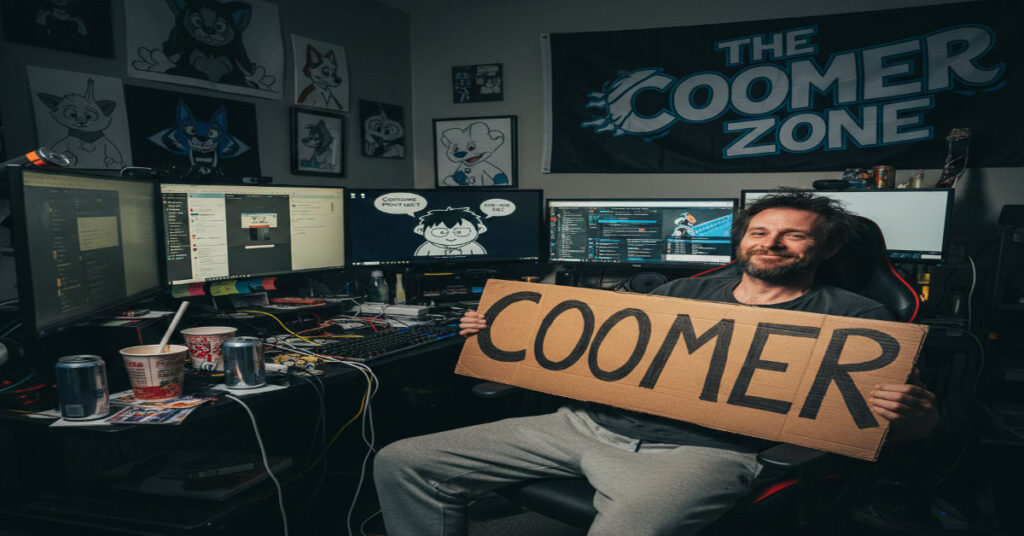
In the vast and ever‑shifting landscape of internet culture, few terms have resonated — and ruffled as many feathers — as coomer. At first mention, coomer may sound like another piece of ephemeral slang, destined for a shelf of forgotten jargon. Instead, it has outlived many meme trends, crossed platforms and entered everyday online vernacular. Coomer hinges on acknowledging that it’s more than an insult it’s shorthand for behaviors tied to compulsive online consumption especially of adult content — a word born on image boards and forums that has since morphed into a cultural talking point about addiction, identity and the digital age.
The term’s origins trace back to the late 2010s particularly around sites like 4chan and Reddit — spaces where slang, caricature, and irony flourish. Used both humorously and pejoratively, coomer typically signifies a caricature of a person who indulges excessively in online stimuli, especially pornography, to the detriment of other aspects of life. Over time, the meaning expanded and was repurposed Gen Z and online communities use it in playful, critical and self‑deprecating ways.
This article unpacks the layers of comer etymology, how it became ingrained in meme culture, the controversies and criticisms surrounding its use, its intersection with anonymity and adult content archives like coomer.su, and how it reveals broader questions about digital behavior in the 21st century. We navigate beyond the jokes to offer context, critique, and insight into a term that is as revealing as it is misunderstood.
Origins of a Meme: From Wojak to Coomer
The story of coomer begins not with a website but with a cartoon. The term emerged around 2018–2019 alongside the proliferation of Wojak meme derivatives — simple, hand‑drawn figures used to represent archetypes in internet subcultures. The Coomer Wojak was depicted as a balding, unshaven man with weary eyes and vacant expression, symbolic of someone engrossed in instant gratification and online pleasures.
What fueled its spread was not some marketing campaign, but the way it tapped into ongoing cultural conversations. As discussions about internet addiction, pornography consumption, and digital overstimulation grew more common, the coomer figure gave a name and face — albeit caricatured — to behaviors many recognized or mocked in others. Over time, coomer became a symbol: at once humorous, critical, and loaded with social commentary.
Internet Archetypes in Meme Culture
| Archetype | Origin | Core Traits | Cultural Commentary |
| Doomer | Online forums (pre‑2018) | Nihilistic, pessimistic | Social disillusionment, burnout |
| Zoomer | Gen Z slang | Youthful, tech‑savvy | Generational identity |
| Coomer | 4chan/Reddit (2018–2019) | Compulsive, overstimulated | Digital addiction & impulse |
| Bloomer | Meme language | Positive, thriving | Aspirational identity |
The coomer meme did not originate as a clinical diagnosis, nor was it intended as an academic term. But its visual and verbal shorthand proved effective — and flexible — as it migrated from niche imageboards to mainstream social media discussions.
Coomer.su and the Dual Edge of Slang and Sites
As coomer gained traction as slang, parallel internet phenomena adopted the name. One such example was coomer.su (or variations like coomer.party), domains loosely associated with archived or scraped adult content repositories. These platforms operated on the ambiguous edge between aggregation and piracy, hosting material outside of creators’ control and lacking formal age‑verification systems.
For many, the coomer.su name conjured not just a slang archetype but a branded space where online consumption was literalized. The association reinforced the stereotype embedded in the word while raising concerns about privacy, legality, and consent in online content sharing. Sites using the coomer label became cultural touchpoints — some viewed them as irony‑laden memes in domain form, others saw them as problematic adult‑site mirrors.
Critics of such platforms point to ethical issues: republishing creator work without permission, exposing minors to explicit content, and contributing to a broader ecosystem where digital boundaries are blurred. Supporters or casual users often treated these sites with detachment — humor or amusement rather than deep moral concern. Regardless, the connection between the slang and the domain names illustrates how internet language and online spaces can reinforce and reshape each other.
Meanings Beyond the Joke: Cultural and Psychological Dimensions
While coomer started as a meme, it quickly became a social commentary tool. In many online communities, the term is less about a specific behavior and more about a pattern of digital overstimulation. People describe someone as a coomer when they humorously suggest that person is “too online” — overly preoccupied with instant dopamine hits, whether through adult content, scrolling feeds, or other forms of compulsive internet use.
Expert Perspective
“Internet slang often reflects broader behavioral trends, serving as shorthand for complex psychological and social phenomena.” — Dr. Emily R. Smith, Cultural Sociologist, on digital slang evolution.
This encapsulates how coomer functions: it’s a linguistic meme but also a mirror to anxieties about self‑control, online impulses, and the pervasive reach of screen culture.
The term also interplays with movements like NoFap — online communities advocating abstinence from pornography and compulsive behaviors. In some spaces, coomer became shorthand for what adherents hoped to avoid, juxtaposed with aspirational identities like Chad or Bloomer — figures symbolizing discipline or thriving in digital life.
Yet another layer is its ironic use. Many Gen Z and meme contexts use coomer in a self‑deprecating way, labeling themselves or their behaviors as coomer‑like not to shame, but to laugh at shared struggles with distraction and habits that feel culturally ubiquitous.
Coomer in Online Contexts
| Context | Typical Usage | Connotation |
| Meme Boards (4chan/Reddit) | Caricature of overstimulation | Critical/derisive |
| Social Media (X, TikTok) | Self‑reference or joke | Ironic/humorous |
| Adult Content Discourse | Critique of habit patterns | Behavioral commentary |
| Self‑Improvement Communities | Warning/aspirational contrast | Motivational/antithetical |
The spectrum of use underscores the term’s adaptability — and potential for misunderstanding. It can be self‑aware humor, stinging insult, or a conversation starter about digital wellbeing.
Controversies: Insult, Stigma & Misuse
Despite its prevalence, coomer is not without controversy. Because the term touches on sensitive topics like sexual content and perceived compulsions, it can be used in stigmatizing ways. Calling someone a coomer in a derogatory context may perpetuate shame or reinforce negative stereotypes about sexuality, impulse control or masculinity.
Critics argue that dismissing real struggles with addiction or emotional regulation as mere “coomer energy” trivializes deeper issues. Some online discussions have veered into toxic territory, blending coomer discourse with misogyny or other harmful rhetoric — although these are not intrinsic to the term’s linguistic roots.
Nevertheless, awareness of context remains crucial. As with many internet slurs or labels, coomer reflects the culture from which it emerged — irreverent, abrasive, and often lacking nuance. That doesn’t make it invalid as cultural commentary, but it does complicate how and when it should be used.
Takeaways
• Coomer originated as a meme representing excessive online or adult content consumption.
• It evolved beyond insult into a broader critique of internet overstimulation.
• Sites like coomer.su tied the slang to real‑world digital spaces, raising legal and ethical questions.
• The term’s meaning varies with context — humorous, critical, or stigmatizing.
• Coomer highlights cultural tensions around attention, impulse control, and digital identity.
Conclusion
What began as a crude piece of internet slang has grown into a complex cultural signifier. Coomer tells us as much about the communities that created it as it does about the behaviors it targets. It lives at the intersection of humor and critique, mocking excess while prompting conversation about digital life’s pressures and compulsions.
Unlike many fleeting memes, coomer has endured because it resonates with broader societal experiences — particularly for generations coming of age in an era where screens mediate so much of existence. Whether deployed as a joke, a self‑label, or a critical observation, it remains a shorthand for grappling with how technology shapes desire, attention, and identity.
In examining coomer, we confront a paradox: the very tools that connect us also distract and define us in unexpected ways. Understanding that is less about judging a label and more about recognizing the digital behaviors it reflects — behaviors that are reshaping individual lives and collective culture.
FAQs
Q1: What does coomer mean?
Coomer is internet slang for someone perceived as overly addicted to online pleasure content, especially pornography.
Q2: Where did the term originate?
It arose around 2018–2019 on forums like 4chan and Reddit as a meme character reflecting compulsive internet behavior.
Q3: Is coomer a clinical term?
No. It’s slang and cultural shorthand, not a medical or psychological diagnosis.
Q4: Why is it controversial?
Because it can stigmatize real behaviors and be used insultingly.
Q5: How is coome’r used today?
Across memes, social platforms and discussions about internet habits — often humorously or ironically.
References
- Dictionary.com. (2019, November 15). Coome’r. Dictionary.com. https://www.dictionary.com/e/memes/coomer/
- Cinezone. (2025, Understanding the Term “Coome’r”: Origins, Culture, and Impact). Cinezone. https://www.cinezone.org.uk/coomer/
- Digital Cultures. (n.d.). Coome’r – Meaning, Origin, Usage. DigitalCultures.net. https://digitalcultures.net/slang/internet-culture/coomer/
- Know Your Meme. (n.d.). Coome’r. KnowYourMeme.com. https://knowyourmeme.com/memes/coomer
- Wikipedia. (2025). Wojak. Wikipedia. https://en.wikipedia.org/wiki/Wojak
- Reddit. (2023). SAM trying to get me in trouble. What’s the definition of “coome’r”? Reddit. https://www.reddit.com/r/ChatGPT/comments/10vtf84/